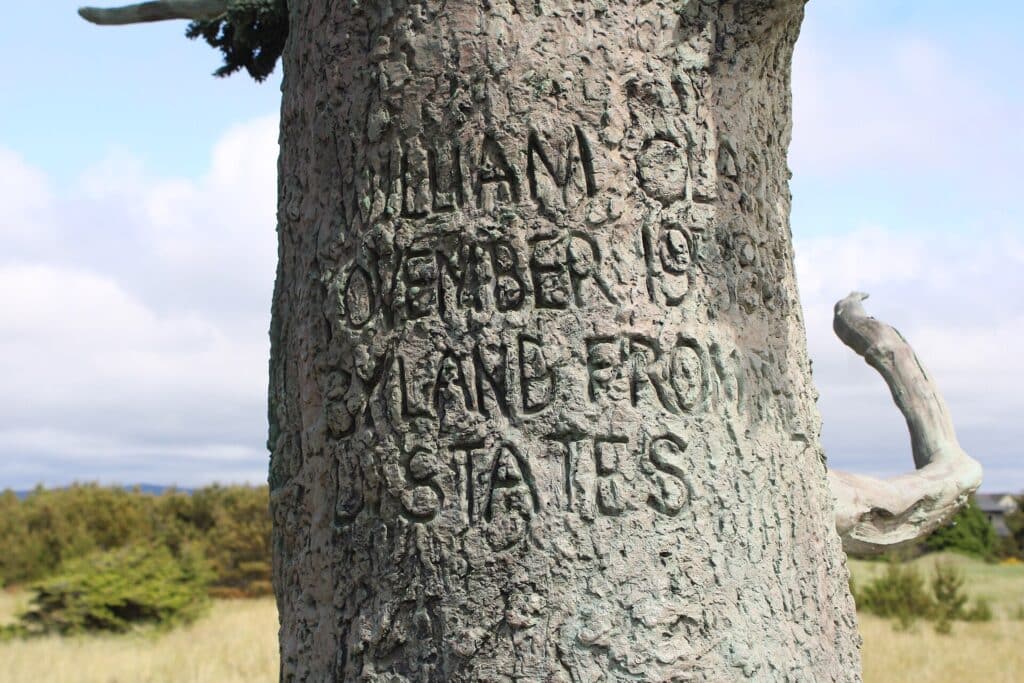
Most towns put their history on a plaque. Long Beach put William Clark’s on a bronze pine tree that stands about 20 feet tall next to a beach trail.
Clark’s Tree in Long Beach, WA, marks the spot, or close to it, where Clark carved his name into a small pine on November 19, 1805. The original tree has been gone for a long time. The story has not.
It is also one of the easiest pieces of history on the Peninsula to visit. It takes almost no planning, and it is a good reminder that people have been walking this beach and wondering what is farther up the coast for a very long time.
Who Was William Clark?
If your American history is a little rusty, you are in good company.
William Clark was one half of Lewis and Clark. In 1803, President Thomas Jefferson sent Meriwether Lewis to lead an expedition across the West, largely to find out whether there was an all-water route to the Pacific. Lewis asked Clark, a former Army officer from Kentucky, to lead it with him.
Clark was born in Virginia in 1770 and grew up mostly in Kentucky. On the expedition, he was the one drawing the maps, and his journals are a big reason we know so much about what they saw along the way, including the day he walked up this beach.
Together, the two captains took a group called the Corps of Discovery up the Missouri River in 1804, over the Rocky Mountains, and down the Columbia River to the ocean. It took them about a year and a half to get here.
After the expedition, Clark spent most of his life in St. Louis. He became governor of the Missouri Territory in 1813, later served as Superintendent of Indian Affairs, and died in 1838.
So when you are standing in front of that bronze tree, you are looking at the farthest point north that one of the best-known travelers in American history reached on this coast.
Clark’s Tree in Long Beach, WA: The Story Behind the Bronze Pine
By the middle of November 1805, the Corps of Discovery had finally reached the Pacific. They were camped on the Washington side of the Columbia River at a place now called Station Camp, near McGowan, and Clark wanted a closer look at the ocean.
So he took 11 men and walked.
They crossed overland to the coast, camped near present-day Ilwaco, and then headed north up the sand from Beard’s Hollow toward what is now the north side of Long Beach. They were following a route Native people had used for generations between the Columbia River and Willapa Bay.
At the farthest point north they reached, Clark did what plenty of travelers have done since. He left his name. In his journal he wrote that he marked “my name on a Small pine, the Day of the month & Year, Etc.”
Then they turned around and walked back.
Nobody knows exactly what happened to that pine. The beach itself has changed too. Sand has built up over the last two centuries, so the shoreline Clark walked sat farther inland than the one you will see today.
In 2003, Long Beach gave him a new tree. Utah artist Stanley Wanlass created the bronze, a weathered pine snag like the ones you see all along this coast, and it was dedicated with a historical reenactment. It carries the words believed to be the ones Clark carved: “William Clark. November 19, 1805. By land from the U. States.”
Walk the Same Stretch of Coast Clark Did
Clark’s Tree in Long Beach sits on the Discovery Trail, an 8.5-mile path between the Port of Ilwaco and Long Beach. At the Long Beach end, the trail follows the boardwalk, so if you have already spent an afternoon on the Long Beach Boardwalk, you have probably been closer to it than you realized.
The tree is not the only piece of the expedition out there. Along the trail you will also find a reconstructed gray whale skeleton, a nod to the whale bones Clark found on the beach, and sculptures of Clark and a sturgeon he found on the sand. At the Ilwaco waterfront, a sculpture shows the birds Clark described as buzzards. They were California condors.
If you want the fuller version of the story, start at Cape Disappointment State Park, then work your way north and finish at Clark’s Tree in Long Beach. You will have covered the same ground he did, with better shoes and a much better chance of a warm dinner afterward.
I would not turn it into a history assignment. Walk out to the tree, read the inscription, look at the beach for a minute, and think about how different this place looked to a group of tired men in November 1805.
Five Weeks Later: The Expedition’s Christmas at Fort Clatsop
Clark did not stay on this side of the river for long. A few weeks after he carved that pine, the expedition crossed the Columbia and built a winter fort near present-day Astoria. They named it Fort Clatsop, after the Clatsop people who lived nearby.
They moved into it on Christmas Day, 1805.
It was not much of a holiday. It rained and hailed through the night, they were out of salt and out of liquor, and Christmas dinner was spoiled elk, spoiled fish, and a few roots. Clark wrote that they “would have spent this day the nativity of Christ in feasting” if they had anything worth feasting on.
Still, they made an effort. The men woke the captains at daybreak with a shout and a song under their windows. The last of the tobacco was divided up, and the men who did not use it got handkerchiefs instead. Clark’s own presents included fleece hosiery from Lewis, moccasins from Joseph Whitehouse, and two dozen white weasel tails from Sacagawea.
A week later, Lewis wrote that he was woken on New Year’s Day by a volley of gunfire in front of their quarters. Then everyone went back to work.
If a rainy December at the coast ever sounds a little gloomy, it helps to remember that the bar was set pretty low in 1805. A warm house, a real kitchen, and a hot tub would have looked like a miracle.
Fort Clatsop is now part of Lewis and Clark National Historical Park, a short drive from Long Beach across the Astoria-Megler Bridge. In past years, rangers have run living history programs at the fort in the days after Christmas, so check the park’s holiday schedule before you go.
If you want to do the whole story in one trip, it works nicely over the holidays. Walk out to Clark’s Tree in Long Beach, drive across the river to the fort, and come back to a house where dinner is not spoiled elk.
Make a Day of It
November at the coast is quieter, and that is part of the appeal. The crowds are gone, the light gets low early, and a walk on the beach feels like more of an event than it does in July.
Spend part of the day out at Clark’s Tree in Long Beach and on the trail. Go into town for lunch. Come back to the house for a while. Head out again when the weather lets you.
If you are looking for more ways to fill the day, our Traveler’s Guide to Long Beach, Washington is a good place to start, and if you are here when the gray whales are moving, our guide to whale watching in Long Beach pairs nicely with that whale skeleton on the trail.
Come Back to a House You Actually Want to Spend Time In
I have always believed a vacation rental should be more than the place where you sleep between activities.
When I started putting game rooms, hot tubs, kitchens, games, gathering spaces, and other amenities into my houses, people would ask why I was doing all of that for a rental. My answer has always been pretty simple. Some of my best memories were made on family vacations, and I wanted these homes to feel special when people arrived.
That matters even more on the Washington coast in November and December.
We get rain. Plans change. Sometimes you come back from a long walk on the beach, and nobody has any interest in going out again.
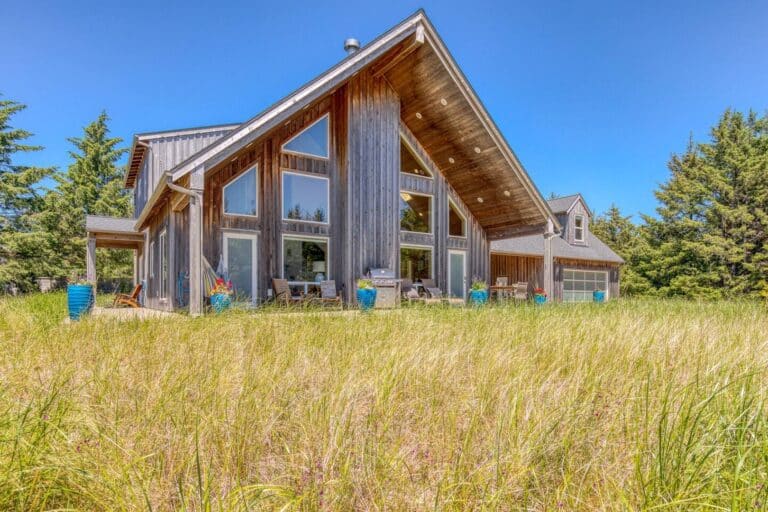
If you are traveling with a larger group, Seagrass has five total bedrooms, including three suites, plus a large game room with a pool table and an 18-foot shuffleboard. Ocean Trail has six total bedrooms, including two master suites, and its downstairs master works well for older guests who prefer to avoid stairs.
Beach Cabin has two suites, a game room, and the treasure hunt, plus its pergola with the hot tub and fire table when the weather cooperates.
And yes, two of our homes are named after the expedition. Lewis works nicely for a couple, two couples, or a small family, and it has a private hot tub. Clark also has two king master suites, indoor games, and the shared game courts with Lewis. After a day on the same beach Clark walked, it seems only fair.
Explore all of our Washington coast vacation homes and find the one that fits your trip.
Frequently Asked Questions
Where is Clark’s Tree in Long Beach, WA?
Clark’s Tree in Long Beach is on the Discovery Trail at the Long Beach end, where the trail follows the boardwalk. It marks the approximate location where William Clark carved his name on November 19, 1805.
Who was William Clark?
William Clark was co-captain of the Lewis and Clark Expedition, which President Thomas Jefferson sent west in 1803. Clark, a former Army officer born in Virginia in 1770, drew the maps and kept detailed journals. He later served as governor of the Missouri Territory and died in St. Louis in 1838.
Is the original tree still there?
No. The original pine is gone. The bronze sculpture by Stanley Wanlass was placed along the trail in 2003 to mark the approximate spot.
What does the inscription on Clark’s Tree say?
It reads “William Clark. November 19, 1805. By land from the U. States.” That is believed to match what Clark carved into the original tree.
How long is the Discovery Trail?
The Discovery Trail is about 8.5 miles long and runs between the Port of Ilwaco and Long Beach, so you can walk a short piece of it or bike the whole thing.
Are there other Lewis and Clark sites near Long Beach?
Yes. Cape Disappointment State Park and the Lewis and Clark Interpretive Center are a short drive south, and the Discovery Trail itself has several sculptures tied to what the expedition saw on that November walk.