If you are planning a coastal getaway near Seattle, your mind probably goes straight to the Olympic Peninsula. Most people do.
I understand why. But about three and a half hours southwest, in the very bottom corner of Washington, there is a 28-mile stretch of sand with a stranger history than almost anyone expects.
I only found Long Beach because Seaside was booked up. That turned out to be one of the luckiest scheduling problems of my life.
What I did not know back then was how many odd stories are packed into this little peninsula. A few of them start before you even see the ocean.
The Drive Down Is Part of the Story
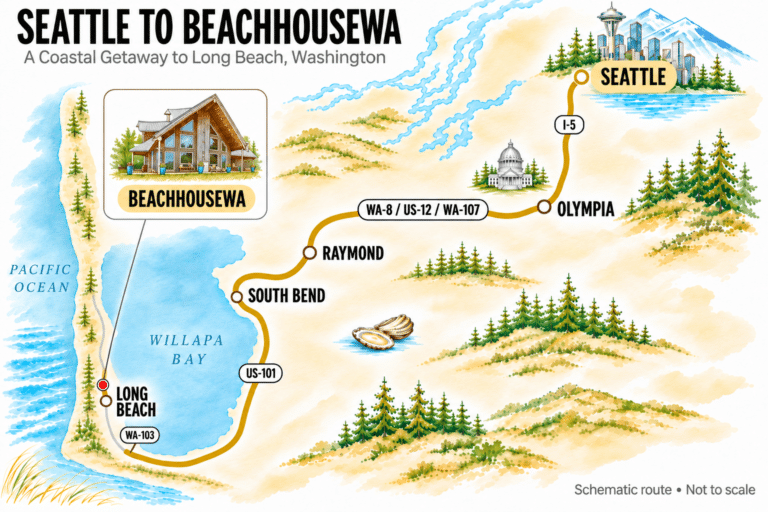
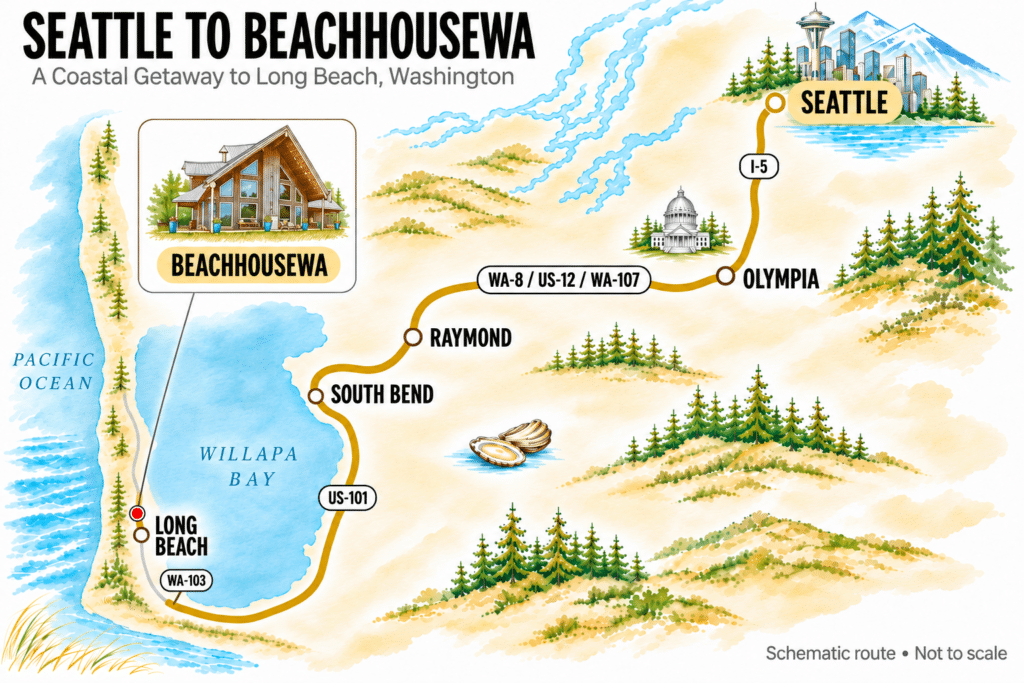
From Seattle, most people take I-5 south toward Olympia, head west toward the coast, and then follow US-101 down along Willapa Bay. Plan on roughly 170 miles and about three and a half hours, depending on traffic and how often you stop.
You will want to stop.
The last stretch hugs the edge of Willapa Bay. Depending on the tide, you see open water, long mudflats, or rows of oyster beds that look like someone drew lines across the bay with a ruler. It changes by the hour, and it never looks quite the same twice.
South Bend Calls Itself the Oyster Capital of the World
The first town that makes people slow down is South Bend. It proudly calls itself the Oyster Capital of the World.
That sounds like the kind of thing every small town says about itself. In this case, there is something behind it. Willapa Bay is the largest producer of farmed oysters in the United States, and a lot of the oysters served around the Northwest started out in the water you are driving past.
If you like oysters, this is the drive to eat them. If you do not, it is still worth knowing that the quiet bay outside your window is one of the hardest-working pieces of water in the country.
The Town That Stole a County Seat
South Bend has another story, and it is my favorite one on the whole drive.
For almost forty years, the Pacific County seat was not in South Bend. It was in Oysterville, a small town at the north end of the Long Beach Peninsula. In 1892, a county vote moved the seat to South Bend. Oysterville did not accept it. People there argued that railroad workers who were only passing through South Bend had been allowed to vote.
So South Bend settled the argument its own way.
On a Sunday morning in February 1893, while much of Oysterville was in church, a group of men from South Bend crossed Willapa Bay, broke into the courthouse, and carried off county records. Accounts still disagree about how much they took. Nobody disagrees about the result. The county seat stayed in South Bend, and it is still there today.
Oysterville never really recovered its old importance, which is part of why it feels the way it does now. Quiet streets, old houses, the bay right there. You can visit the town that lost a county seat to a raiding party and be back at the beach in about twenty minutes.
If you are coming in winter, the same shoreline is also one of the best places on the peninsula for winter birdwatching.
The Beach Here Is Officially a Highway
This is the fact that gets the biggest reaction from first-time guests.
Back in 1901, Washington declared its ocean beaches in this part of the state to be public highways. Today the sand along the Long Beach Peninsula is part of the state highway system, with a 25 mph speed limit and posted rules about where and when you can drive on it.
That means one of the longest beaches on any peninsula in the world is also, technically, a road.
You do not have to drive on it to enjoy it. Plenty of people never do. But the first time you see a pickup cruising slowly along the waterline while kids fly kites twenty feet away, it starts to make sense why people here talk about the beach like it is part of the neighborhood. If you are a car person, our Rod Run to the End of the World guide shows how far that idea goes.
Check the posted beach access rules before you drive. Some sections close seasonally, and soft sand is not forgiving.
A Train Here Once Ran on the Tide Table
Most trains run on a timetable. The one on this peninsula ran on the tides.
Starting in 1889, a small railroad carried passengers from Ilwaco up the peninsula toward Willapa Bay. Travelers arrived in Ilwaco by steamer, and the steamers could only reach the dock when the tide was high enough. So the train schedule followed the water. When the tide changed, the timetable changed with it.
Locals called it the Clamshell Railroad. It kept running until 1930, when cars and roads finally took over.
I like this one because it says a lot about the place. For a long time, the ocean decided when you got here. In some ways it still does. If you are around Ilwaco during the holidays, pair the history with the Crab Pot Christmas tree.
Cape Disappointment Got Its Name From a Mistake
At the southern tip of the peninsula, where the Columbia River meets the Pacific, is a headland with one of the gloomiest names on the coast.
The disappointment was not about the view. It was about a river that someone could not find.
In 1775, the Spanish explorer Bruno de Heceta sailed past this spot and saw signs of a great river. His crew was sick with scurvy, and he could not take the risk of exploring it. In 1788, British trader John Meares came looking with Heceta’s notes in hand. All he saw were breakers and shoals across the entrance. He decided there was no river at all and named the headland Cape Disappointment.
Four years later, in 1792, the American captain Robert Gray crossed that same dangerous bar and sailed into the river. He named it the Columbia, after his ship.
Meares was wrong. The name stayed anyway.
Today the cape is home to Cape Disappointment State Park and a lighthouse first lit in 1856, considered the oldest working lighthouse in the Pacific Northwest. Lewis and Clark reached this same stretch of coast in 1805, and Clark even carved his name into a tree nearby. For trails, viewpoints, and lighthouses, use our visitor’s guide to Cape Disappointment State Park.
Why a Coastal Getaway Near Seattle Should End With a Night Here
You can see a lot of this in one long day. I would not recommend it.
The drive is the warm-up. The real reward comes later, when the day-trippers head home, the light gets low over the water, and the beach goes quiet. That is when Long Beach feels most like itself.
A coastal getaway near Seattle should leave you rested, not just tired from the car. Give yourself at least one night. Walk the beach in the morning before anyone else is out. Say hello to Jake the Alligatorman at Marsh’s Free Museum. Eat oysters where they were grown.
Then go back to the house and do nothing for a while. That part matters too.
Come Back to a House You Actually Want to Spend Time In
When I was a kid, my family stayed at a vacation rental with a playroom upstairs. In it was a huge set of plastic tracks for Hot Wheels. I had Hot Wheels at home, but I had never had the tracks. My brothers and I spent the entire day building them.
I still remember that day. It is one of those core memories that never really goes away.
That is a big part of why I build my homes the way I do. The building phase is mostly behind me now, so lately I spend a lot of evenings refining. I research games, books, and toys, looking for the best version of each one. I want things families will actually do together, not just stuff to fill a shelf.
After a long drive and a day of oysters, lighthouses, and old courthouse stories, that is the kind of place you want to come back to.
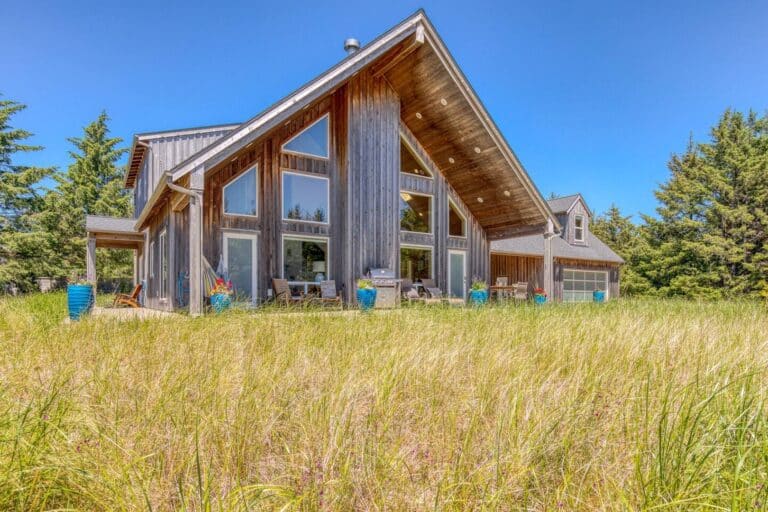
If you are traveling with a larger group, Seagrass has five total bedrooms, including three suites, plus a large game room with a pool table and an 18-foot shuffleboard. You can read more about how it was designed in the story behind Seagrass. Ocean Trail has six total bedrooms, including two master suites, and its downstairs master works well for guests who prefer to avoid stairs.
Beach Cabin has two suites, a game room, and the treasure hunt, plus its pergola with the hot tub and fire table when the weather cooperates.
Lewis works nicely for a couple, two couples, or a small family. Clark also has two king master suites, indoor games, and the shared game courts with Lewis.
Explore all of our Washington coast vacation homes and find the one that fits your trip.
A Few Questions Before You Go
How long is the drive from Seattle to Long Beach, WA?
Most drives from Seattle take about three and a half hours and cover roughly 170 miles. Traffic around Seattle, Tacoma, and Olympia can add time, especially on Friday afternoons.
What is the best route from Seattle to the Long Beach Peninsula?
The most common route is I-5 south toward Olympia, then west toward the coast and south on US-101 along Willapa Bay. That last stretch passes South Bend and the oyster country of the bay.
Can you drive on the beach in Long Beach, WA?
Yes. The beach is part of the state highway system, with a 25 mph speed limit. Some sections close seasonally, so check the posted beach access rules and avoid soft sand.
Is Long Beach a good coastal getaway near Seattle in winter?
Yes, if you like quiet beaches, storm-watching weather, birdwatching on Willapa Bay, and fewer crowds. Pack rain gear, keep plans flexible, and choose a place to stay that is comfortable on a rainy afternoon.